
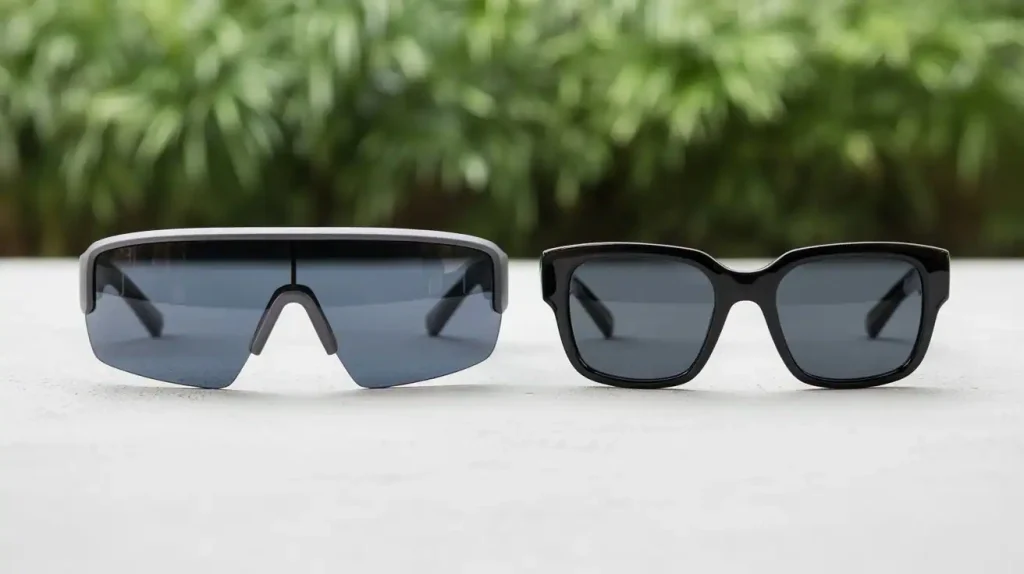
Over the past few years, I’ve reviewed an entire display case worth of smart glasses for Lifehacker, and if I’ve learned anything, it’s that their capabilities and performance don’t always align with their sometimes hefty price tags. Today, I’m pitting the least expensive pair of display glasses I’ve evaluated against the most expensive: The RayNeo Air 4s are currently listed for $248 from Amazon, while the XReal One Pros are on sale for $599. How much difference does that $350 or so make? Let’s find out.
(For more detail, check out my full reviews of the XReal One Pro and the RayNeo Air 4 Pro.)
Display: HDR10 vs. X-Prism optics
Both of these glasses feature excellent, vibrant high-definition displays. Looking through either will feel like watching a high-end TV floating in the air in front of you, and either will serve you well if you’re just trying to entertain yourself on a bus trip. But in a head-to-head visual comparison, the pricier XReal Ones take the win. Their flat-prism optics and superior stray light control result in “blacker” blacks and the appearance of greater contrast. On the other hand, Ray Neo Air 4s are the first display glasses with HDR10 graphics; theoretically this means a much wider color range, but in practice, I wasn’t able to see a difference in color depth—and believe me, I tried. Overall, I prefer the picture from XReal.
Winner: XReal One Pro
Video: Color range vs. size
If you’re binging Search Party on a red eye to Milwaukee, you’re going to have a slightly better experience with a pair of XReal One Pros than RayNeos. As discussed above, RayNeo Air 4 Pros’ HDR10 graphics theoretically give you more than a billion colors to enjoy, and their Bang & Olufsen tuned audio is excellent, especially the spatial audio feature. But the XReals have Bose audio, which is also excellent, and a 57° field-of-view, where the RayNeos’ top out at 47°. Those 10 extra degrees make a big difference in filling up your vision. More importantly, XReal One Pros let you adjust the size of the virtual screen, set it to “ultra-wide,” and even anchor it in place, while RayNeo’s glasses are more what-you-see-is-what-you-get—you put ’em on, and there’s the screen, with no ability to adjust its size or placement.
Winner: XReal One Pro
Gaming: Responsiveness and immersion
The XReal One Pros’ higher-end internals shine when it comes to gaming. The 3ms motion-to-photon latency and 120Hz refresh rate means fast-paced games played on a Steam Deck or PS5 run like butter. Plus, being able to anchor the screen means you won’t be lagging when you turn your head—but this is only an issue if you’re “serious” about gaming. The RayNeo Air 4 Pro also offers a 120Hz refresh rate, and work perfectly for more casual gaming. The XReal have a slight edge here, then, but only for the most hardcore players. The rest of us likely won’t notice much difference.
Winner: XReal One Pro
Productivity: Edge blurriness
If you’re trying to use your display glasses to get work done, the XReal One Pros are a better choice. RayNeo Air 4 Pros tend to show some blurriness around the edges of their display. It’s hardly a problem with gaming and videos, but the first time you glance up at the URL of your browser, it becomes an issue, especially since you can’t anchor the screen, so moving your head won’t help you see more clearly. XReal One Pro glasses have very little edge blurring and a stationary screen option, making them a more viable choice as a replacement for a laptop screen at the coffeeshop.
Winner: XReal One Pro
Ergonomics: The lighter the better
At 76g (2.68 oz), RayNeo Air 4 Pros are one of the lightest pairs of display glasses on the on the market. XReals weigh in at 87g (3.07 oz). That 11-gram difference doesn’t sound like much, but on your nose bridge over a two-hour movie, it’s noticeable. Both glasses feature adjustable temples and nose-pads to make sure you can position them in your optical sweet spot, but the XReals come in two sizes, based on your IPD (the distance between your eyes). This ensures the “sweet spot” of the lenses is perfectly aligned with your pupils, reducing eye strain during long sessions. Still, the lighter Air 4 Pros are more comfortable over the long haul.
Winner: RayNeo Air 4 Pro
The RayNeo has a high floor but a low ceiling. They offer a great experience right out of the box, especially for $250. But other than a few gimmicky features like making 2D photos look 3D (which doesn’t look great) the RayNeos are basically “what you see is what you get.” The XReal One Pros have a higher ceiling: If you want to do more with your display glasses than watch a movie or play a quick game, they are modular, so you for another $100, you can add the optional XReal Eye to get full 6DoF spatial tracking and add augmented reality features and a camera—very cool options for taking 3D photos and video. For $199, you can add the Beam Pro to turn your glasses into a standalone computer. Of course, all of this assumes you have a reason to want to do this, and so far, I haven’t found a truly compelling use for any of the XReal One Pros’ “added” features. Your mileage may vary, but in my experience, they’re a good way to watch movies and play games. The rest is bells and whistles.
Winner: XReal One Pro
Price: The most important feature?
The RayNeo Air 4 Pros offer the best value in AR right now, full stop, offering a flagship-level display for a budget price. For $248, you are getting a 201-inch wearable display that outperforms some TVs in terms of refresh rate (120Hz) and brightness (1,200 nits). The XReal One Pros, at $599, are mostly asking you to pay a premium for advanced features like the X1 Spatial Computing Chip that allows the screen to stay “anchored” in space, and the potential addition of the AR-enabling Eye device. Very cool stuff, but not necessary for everyone.
Winner: RayNeo Air 4 Pro
The final verdict: It’s a tie
After all of that, I’m calling this one a tie. I can’t declare the RayNeos the winner when the XReal One Pros outclass them in just about every category—but on the other hand, $350 is a big difference in price. While power-users and early-adopter types will want the XReals, I imagine most people just want display glasses to entertain themselves on flights or to privately watch a movie projected on the ceiling in the middle of the night. For that, RayNeo 4 Pro glasses are more than adequate. They’re not as good as XReal One Pros, but the difference is far from a deal-killer. And heck, you can buy two pairs for less money than one pair of their pricier competitor.
Here’s the bottom line: If you just want to watch Dune on an airplane, buy the RayNeo Air 4 Pros. If you want to build a virtual office at a coffee shop, or you can’t stand not having the best possible product, save up for the XReal One Pros.